Build what your business uniquely needs.
Everyone has agents. The difference is that you can create agents, listeners and workflows for just about anything - and by doing so grow operational capability that is unique to your business, governed and compounding. That is what "operating system" means.
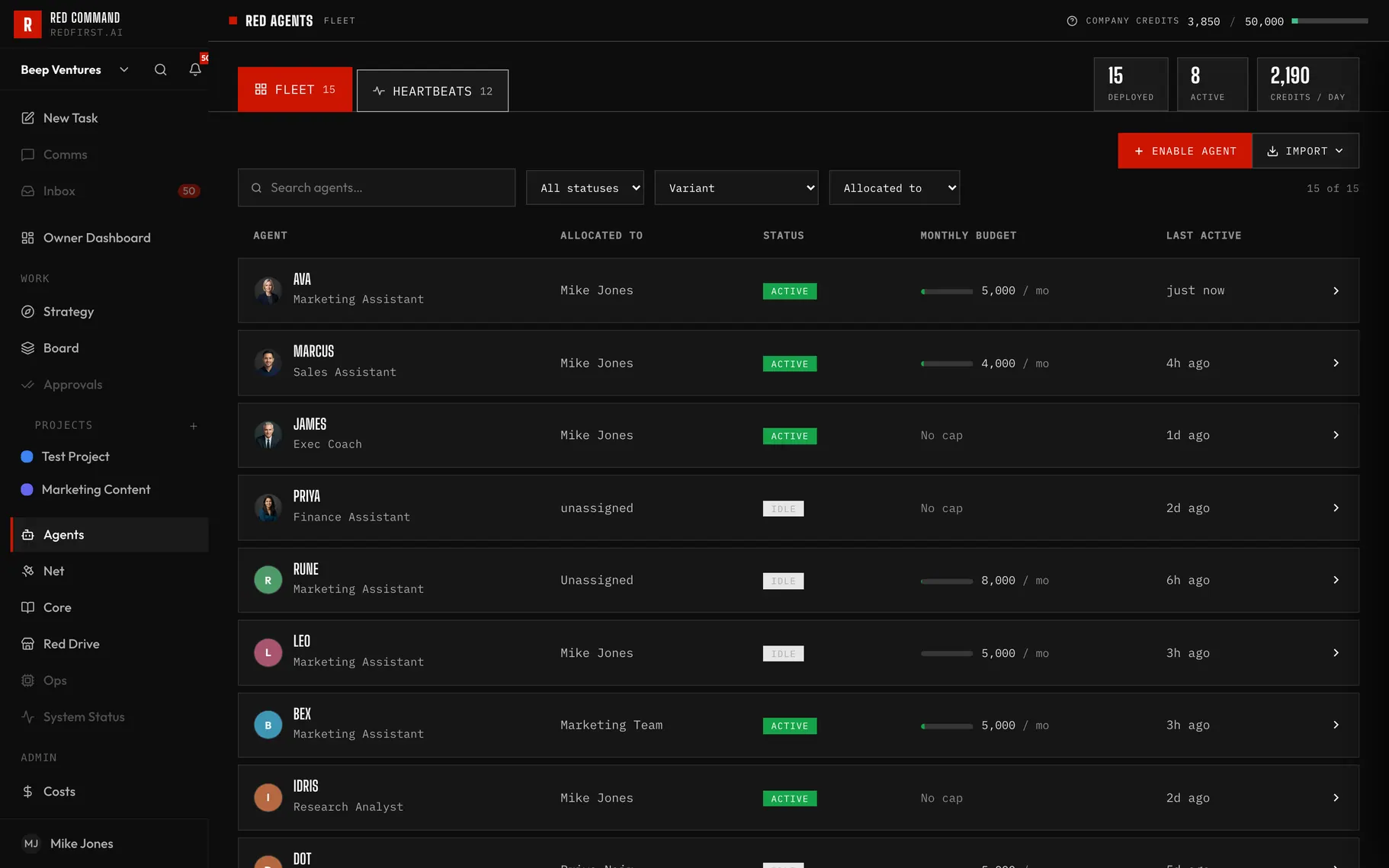
Every agent on one screen.
Who it is assigned to, what it is spending, when it last checked in, what it is working on.
They reach out first.
A HeartBeat is a scheduled cadence - morning check-in, weekly review - where the agent gathers context and comes to you.
Every agent has a workspace.
Drop into any agent's Breakout for focused work: chat, documents, skills, integrations and settings.
Import what you have - and upgrade it.
Most businesses already have AI somewhere: a Custom GPT the marketing lead built, a Claude Code setup an engineer runs, an n8n flow. Import is how you start fast - and the mapping is the value, not the migration.
The same gates as your people.
There is no separate, weaker permission system for the bots. An agent structurally cannot see what its people could not - which is the difference between "we adopted AI" and "we can let AI near real data".
The useful ones are the ones we never shipped.
Agents, listeners and workflows are three ways to build the same thing: operational capability that fits your business and nobody else's. All three use one create-approve-deploy pattern.
builds a freight-quote agent that prices from live carrier rates and the account's history.
builds a pitch-research workflow that runs the same way every time, versioned and costed.
builds an intake triage listener that watches the referral inbox and flags what needs a human today.
None of these is a feature RedOS shipped. They are capabilities the client grew - governed, compounding, and impossible for a competitor to buy off a shelf.
What an agent gets by living here.
The properties a governed agent carries that a script on a laptop cannot, and where each one stands today.
| Property | What it means | Status |
|---|---|---|
| Designed | Created through a visual, agent-assisted builder with an approval gate before anything touches a user. | Live |
| Deployed | Cloud-native instances with unique identity and persistent memory. They survive laptops closing, restarts and scaling. | Live |
| Governed | The same rank, departments and explicit grants as your people, checked by one fail-closed authority at the data layer. | Live |
| Grounded | Just-in-time context from the Knowledge Brain, including the Company Intent spine - and shared agents write their work back. | Live |
| Budgeted | Per-agent budgets. Exhaustion stops the agent and files an approval. Spend against budget visible in real time. | Live |
| Proactive | Heartbeats: scheduled cadences where the agent gathers context and reaches out first. | Live |
| Assigned | Private 1:1 with fully isolated memory, or shared with a team whose work becomes organisational knowledge. | Live |
| Model-agnostic | Tiered routing - quality, balanced, fast, cheap - per tenant and per agent. A better model tomorrow is a config change. | Live |
| Personified | A name, personality and photo at deploy time; reachable through Comms, its Breakout, Telegram or email. | Live |
| Extensible | Custom Surfaces: tools your team built elsewhere run as signed, least-privilege tabs inside the Breakout. Signed bytes are served bytes. | Partial |
| Imported | Bring an existing Custom GPT, Claude Code setup or n8n flow; the appraisal maps it in with a mandatory security fix and a governance wrap. | Partial |
Agents are one component.
See what your business would build first.
A Red Brief maps the agents, listeners and workflows your business would build first, and what they would be worth.
Book a Red Brief